Showing posts with label Specials. Show all posts

Thursday, February 17, 2011

Similar Genes, Different Personalities


By LISA BELKIN

I had an NPR driveway moment earlier this week, listening to a piece by Alix Spiegel about why siblings are so different.

After all, she points out, you are far more likely to share physical characteristics with a sibling than you are with someone randomly chosen from the population. This is dramatically true of cognitive abilities as well.
But personality? Studies have found that when it comes to things like extroversion or conscientiousness, siblings are similar only 20 percent of the time, which is only the slightest bit higher than a comparison to a random stranger.

At first that sounds impossible. Wouldn’t people who share genes and parents and a childhood home be likely to turn out alike?

Then I thought of my own family. My brother and sister and I do look alike, and (though we would not have conceded this when we were much younger) we are all similar in intelligence. But in so many other ways we are opposites. Get the three of us together and at least someone in the room can be described as garrulous or taciturn, cheap or indulgent, meticulous or sloppy, dramatic or cool. A Venn diagram would have some overlap, but not much. How is this possible?

There are three theories, Spiegel reports. The first, known as “divergence,” postulates that children are competing for their parents’ “time, love and attention,” and, as Darwin pointed out, organisms tend to “diverge” and specialize to minimize direct competition. “So if one child in a family seems to excel at academics,” Spiegel says, “the other child — consciously or unconsciously — will specialize in a different area, like socializing.”

The second theory, that of a nonshared environment, argues that we only seem to be “growing up in the same family as our siblings,” when in fact we are being raised in measurably different households. We experience the same events at different ages; we have different numbers of older and younger siblings; we are born to different parents — older or younger, wealthier or struggling, happier or less so, more experienced, less energetic.

And, finally, there is the theory of “exaggeration.” It is similar in result to “divergence,” though different in its cause. A child who might be considered outgoing and social in a family of introverts, becomes the “quiet one” in a family of extroverts. She then thinks of herself that way, chooses quieter friends and gradually becomes somewhat quieter. (As parents we are supposed to make sure this doesn’t happen — that we don’t compare our children. That is, of course, impossible. But it’s the reason I’m not mentioning my own children in this post. Exaggeration and divergence may be the natural order of things, but declaring in print that one child is vanilla and the other is chocolate is still a bad idea.)

NPR is spending the week looking at siblings. Apt timing. As Spiegel said:
…as you eat your turkey, look across the table. There, you may see a brother, a sister, a step-sibling, a twin. And maybe they’re your friend, and maybe they’re your enemy, but one thing is for certain: Their very existence has had a profound influence on your life.

Tuesday, February 15, 2011

Women prefer men in red, study shows


(CNN) -- Men on the prowl for a date may want to add red to their wardrobe.
A new multicultural study shows red is no longer just a sexy color for women. Men in red are considered just as appealing.

Women in China, the United States, England and Germany said they found men pictured wearing red, or surrounded by the color, more sexually attractive.

Women consider men in red as higher in status and more likely to climb the social ladder, according to Andrew Elliot, the lead author and professor of psychology at the University of Rochester.
The perception of high status is what leads to the attraction, he says.

Despite the cultural differences among women surveyed, the results were consistent, according to the study.
However, researchers said, the color only enhanced perceptions of status and romance, but not did not make the man seem more likable and kind.

"Women's romantic preferences are of great interest ... and although the popular media often portrays female sexuality as a mystery, scientific research has revealed several factors that influence women's attraction to men," the study says.

Authors attributed the color's appeal to its historic use as a symbol of wealth and status. It is used in bold body paintings and necklaces in rituals and ceremonies in various cultures, including the Masai in east Africa.
"In primitive societies, sacred objects were painted or coated in red to enhance their potency and convey a sense of great importance," the study says.

"In ancient China, Japan, and sub-Saharan Africa, red was viewed as a symbol of prosperity and high status. Classical Romans called the most powerful men ' "the ones who wear red.' "
The red effect was limited to women's perception of men. Color did not make a difference when men rated the appeal of another male.

Authors conducted seven experiments, including the effect of red and white on a man's attractiveness.
The study was published in the Journal of Experimental Psychology.

Wednesday, February 9, 2011

Woman's cellphone swallowed by crocodile ringing


Here's something strange that shows how sturdy some Nokia phones can be. There can be crocodile resistant!

A crocodile named Gena at an aquarium in Dnipropetrovsk, Ukraine swallowed the mobile phone nearly a month back when a visitor, Rimma Golovko trying to photograph the reptile dropped it in the water, according to several media reports.

The zoo authorities did not believe the woman that the 14-year-old toothy reptile ate her Nokia phone until they called it and heard it ringing inside the croc's stomach.

An aquarium employee Alexandra was quoted by the Associated Press as saying, “The phone started ringing and the sound was coming from inside our Gena's stomach, and we understood s[he] wasn't lying."
Surprisingly, the device survived the amphibious reptile's teeth and acids in stomach.

Despite being the leader of the group, Gena has not been playing with other fellow African crocodiles. Apparently he is depressed and in pain after swallowing the device.

Croc in pain?

Though the phone has not been damaged, Gena has been unwell. Since the incident, the crocodile has refused to eat food, and has become silent.

The doctors have tried feeding him live quail, which was injected with vitamins and a laxative, but Gena did not eat it.
Alexandra added, "His behavior has changed. He moves very little and swims much less than he used to.”
Despite being the leader of the group, Gena has not been playing with other fellow African crocodiles. Apparently he is depressed and in pain after swallowing the device.

According to Eduard Manukyan, aquarium's representative, the crocodile's condition has been worsening day by day.

Gena may undergo operation

If the croc continues refusing to eat, he will be taken for an X-ray next week.
Currently, the authorities are trying to warm up the air and water to speed up Gena's digestion.

Removing the cellphone through operation will be the last resort, as a surgery in reptiles usually take around three weeks to heal. Also, the move can prove dangerous both for the Gena and the vets.
Dnipropetrovsk chief veterinarian Oleksandr Shushlenko stated that whether the crocodile will undergo surgery or not will depend on where the celephone is located.

He added, "We don't have much experience working with such large animals."

The zoo administrators stated, “We have ordered special transport to bring Gena to the vet.
"We pray only that he survived the operation. We are so worried about him.”

Meanwhile Golovko is only worried about her cellphone and wants to get it back, as it has her contacts and memorable photographs.

Saturday, January 15, 2011

Breastfeeding boosts schoolboys' brains, not girls'


Breastfeeding improves later academic performance in boys but appears to have no such effect in girls.
Wendy Oddy at the Telethon Institute for Child Health Research in Subiaco, Western Australia, and colleagues, examined whether having been breastfed affected the test scores of over 1000 10-year-olds.
Studies have suggested that children who were breastfed have higher IQs than those who were not, but few separated out boys and girls. Mothers who breastfeed are on average wealthier and more educated, so Oddy's team accounted for these factors.

Boys who were mainly breastfed for at least six months scored 9 per cent higher in mathematics and writing tests, 7 per cent higher in spelling and 6 per cent higher in reading, compared with boys fed with formula milk or breastfed for shorter periods. There were no significant differences in results for girls.

"We know that breast milk contains the optimal nutrients for development of the brain and central nervous system," says Oddy, but the gender differences were surprising.

Hormone link

Oddy points out that other studies have suggested boys are more vulnerable to stress and adversity during critical periods of brain development. She speculates this could be because girls seem to be protected by higher levels of oestrogen during childhood. She says the improved academic performance of boys could be explained by oestrogen in breast milk having similar neuro-protective effects.

Some studies have suggested that fatty acids uniquely present in breast milk explain research showing that it can help babies become more intelligent. Whether or not these fatty acids help in boosting IQ may be linked to the presence of certain gene variants involved in their processing.

A large randomised trial conducted by Michael Kramer at McGill University in Montreal, Canada, concluded that prolonged breastfeeding was linked tohigher IQ and academic ratings by teachers in Belarussian children at age 6, but found no sex differences.

"These results add to the evidence that longer and exclusive breastfeeding is beneficial for cognitive development," says Kramer.

The World Health Organization recommends exclusive breastfeeding for at least six months, and states that failing to do so impairs intellectual and social development.

Source: newscientist.com

Wednesday, January 12, 2011

The World’s Most Beautiful Libraries

1-Abbey Library St. Gall in Saint Gallen, Switzerland


2-The Astronomy Library of the University of Utrecht in The Netherlands


3-Bristol Central Library


4-The British Library reading room at the centre of the Great Court of the British Museum in London, England.


5-Central Library of Vancouver in Vancouver, Canada


6-Delft University Library in The Netherlands


7-José Vasconcelos Library


8-Klementinum National Library in the Czech Republic


9-The Library of Melk Abbey, in Melk, Austria


10-Library of Parliament (reading room), Ottawa, Ontario, Canada


11-The Los Angeles Central Library in Los Angeles, California


12-Österreichische Nationalbibliothek (The Austrian National Library) in Vienna, Austria


13-Philology Library of the University Berlin in Russia


14-Royal Library El Escorial in Spain


15-City Library of Stockholm in Sweden


16-The Suzzallo library of the University of Washington in Seattle, Washington


Source: The Great Geek Manual .com

Tuesday, January 11, 2011

Top 10 unusual winter sports

There is more to winter travel than skiing and snowboarding. Nontraditional winter sports and activities have sprouted up all over the world, catering to adventurers who crave new ways to get their adrenaline pumping.
Here are our ten favourite out-of-the-ordinary outdoor sports for your next winter vacation.

1. Polar bear swimming in Korea

Each January in Busan, thrill-seeking locals jump into the freezing cold water of the Korea Strait in nothing but their bikinis and swim trunks. The Polar Bear Swim competition has taken place at Haeundae Beach every year since 1988. It is the Korean way of welcoming good health in the new year. Get ready to run 10 meters across the sand, leap into the icy water, and then swim 80 meters toward the finish line. Even though it is technically a race, the Korean Tourism Organization (www.visitkorea.or.kr) points out that the Polar Bear Swim is less about competition and more about spreading good cheer.

2. Ski biking in Colorado

If bicycling in the snow sounds like trouble, try riding a bike outfitted with skis instead of wheels down snowy slopes in Colorado's Rocky Mountains. Durango Mountain Resort (www.durangomountainresort.com) has long offered ski biking as one of its winter activities. The ski resort holds an international ski bike festival once a year for participants and spectators alike. Be sure to take a lesson or two before going out on the slopes for the first time; it is not as easy as the YouTube videos make it look.

3. Ice karting in Finland

What could be more fun than go-kart racing on ice? In Kuusamo, Finland, give reckless driving a try on a frozen lake. Race against a few friends or strangers at Ruka Adventures (www.rukaadventures.fi/en) with the chance to win a medal. After the adrenaline rush, relax with some complimentary coffee, tea, sweets and sausages.

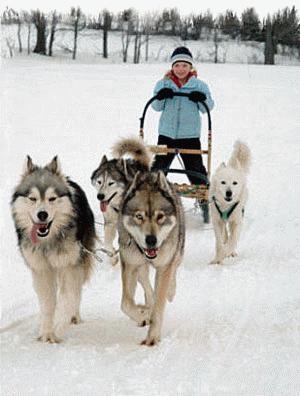
4. Dog sledding in Alaska

Dog sledding, or mushing, is Alaska's official sport. Enjoy the ride while a team of adorable huskies pulls you along for either a short sprint or a long journey. Dog sled rides can last anywhere from minutes to days, depending on your interests. Alaska Best Wilderness (www.alaskabestwilderness.com), based in Tanana, has 11-day backpacking expeditions that combine mushing, trekking and rafting. If you just want an afternoon with the beautiful sled dogs, Sun Dog Express (www.mosquitonet.com/~sleddog) in Fairbanks offers guided tours starting from just half a mile long.

5. Skijoring in Minnesota

For a snowy adventure with your own dogs, try skijoring in Minnesota. Skijoring is a combination of cross country skiing and dog sledding in which a person on skis is pulled along by his or her pups. The Midwest Skijorers Club (www.skijor.org) holds skijoring events around the Twin Cities in Minnesota.

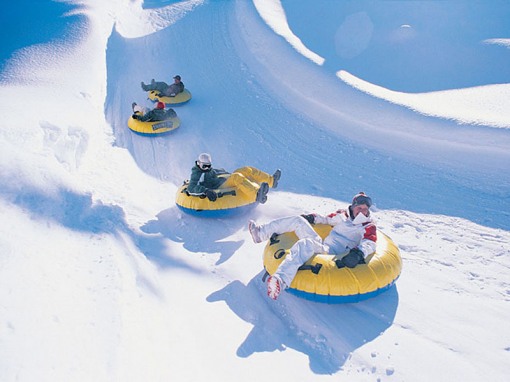
6. Snow tubing in Canada

Snow lovers who do not ski or snowboard will love snow tubing. Basically sledding in a tube, snowtubing is easy, cheap and incredibly fun. Rock Ridge Recreation Park (www.rockridgetubing.com) in Ontario is especially dedicated to the sport and features six tubing runs. Attach a few tubes together to go down the slopes with your friends or family. Rock Ridge's season this year begins the day after Christmas.

7. Ice climbing in Chile

True exhilaration can be found just outside of Santiago, Chile in Cajón del Maipo. There, the awe-inspiring El Morado Glacier sets the scene for a simultaneously magnificent, terrifying and thrilling ice climbing trip. Trek out to the southwest side of Cerro El Morado where the most adventurous of adventurers climb the hanging glacier. The sights are spectacular, so remember to bring a camera.

8. Ice sailing in Poland

Feel the blustery wind rush over you as you sail across Poland's Great Masurian Lakes when they freeze over in the winter. With no waves to slow you down, the sport brings new meaning to the term "smooth sailing". Iceboats can reach very high speeds, so racing should only be attempted after you get the hang of basic sailing.

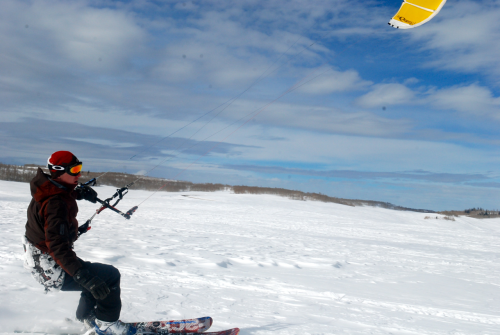
9. Snowkiting in Utah

While many snowkite enthusiasts use a board or skis, all you really need to go snowkiting is a power kite and an appetite for excitement. Glide down the slopes in snowy Utah and let the wind pull you up into the air. Lessons can be found at the Utah Kite Addiction (www.utahkiteaddiction.com) snowkiting school in the Ogden Valley. Beginners should take a class to learn the basics about snowkiting safety.

10. Shark ice fishing in Greenland

The Greenland Shark Challenge (www.greenland-guide.gl/sharkchallenge) is anything but your average fishing trip. Battle icy waters to catch Greenland's largest fish, the Greenland shark. These sharks can get reach 21 feet and 2,200 pounds, so reeling one in is a feat worthy of bragging rights. The Challenge takes place in the beautiful town of Uummannaq which boasts stunning views of glaciers and mountains. Book a fixed week-long fishing tour or arrange for an individual angling trip with a local fisherman.

Source: World Tour Guide 

Friday, January 7, 2011

Indian village bans mobiles for unwed women


LUCKNOW - A northern Indian village has banned unmarried women from using cell phones for fear they will arrange forbidden marriages that are often punished by death, a local official said Wednesday.

The Lank village council decided unmarried boys could use mobile phones, but only under parental supervision, council member Satish Tyagi said. Local women's rights group criticized the measure as backward and unfair.

Marriages between members of the same clan are forbidden under Hindu custom in some parts of north India, where unions are traditionally arranged by families. In conservative rural areas, families sometimes mete out extreme punishments, including so-called honor killings, for those who violate marriage taboos. In some cases, village councils themselves have ordered the punishments, though police often intervene to stop them.

The Lank village council feared young men and women were secretly calling one another to arrange forbidden elopements.

Last month, 34 couples eloped in Muzaffarnagar district, where Lank is located in the northern state of Uttar Pradesh, police said. Among the couples who eloped, eight honor killings have been reported in the last month, police said.

"Three girls were beheaded by the male members of their family after they eloped" with boys from their same clan, said police assistant director general Brij Lal in the state capital of Lucknow.

Rulings by village councils — called panchayats and comprised of village elders selected by the community — are not legally binding in India, but are seen as the will of the local community, and those who flout them risk being ostracized. In Uttar Pradesh, panchayats are particularly powerful and have declared that boys and girls of the same clan are essentially siblings.

The cell phone ban for unmarried women is part of a wider, regional effort to curb intraclan marriage among the 3 million population of western Uttar Pradesh, Tyagi said. The Lank council ruling, which applies to around 50,000 people, is being considered by councils in the nearby villages.

"The village council members feel that cell phones helped in elopement of young couples," he said by cell phone from Muzaffarnagar.

The conflict is relatively new for the Indian region, where most marriages are still arranged by the parents, sometimes without the couple meeting before the wedding.

But young people are mingling more these days, with more women in schools and offices and increased access to the Internet, cybercafes and social networking sites. They are also watching more Western TV shows that focus on independence and individuality, sociologists say.

Cell phones, meanwhile, have become so common and affordable that even city slum dwellers, rural day laborers and children have them. Across the nation of 1.2 billion, there were more than 670 million cell phone connections as of August, with the number growing by nearly 20 million a month, according to government figures.

The local women's rights group Disha said banning cell phone use over sexual politics demonstrated the councils' archaic mindset, and warned it could put girls at a disadvantage in other areas of life.

"These help in easy communication, which in turn help these youth to get jobs. One cannot discriminate use of these contraptions on basis of sex," Disha president K.N. Tiwari said.

Copyright © 2010 The Associated Press. All rights reserved. The information contained in the AP News report may not be published, broadcast, rewritten or redistributed without the prior
written authority of The Associated Press.

Thursday, December 30, 2010

Proboscis Monkey


The Proboscis Monkey (Nasalis larvatus), known as the bekantan in Malay, or simply the Long-nosed Monkey. It is a reddish-brown arboreal Old World monkey that is endemic to the south-east Asian island of Borneo. It belongs in the monotypic genus Nasalis, although the Pig-tailed Langur has traditionally also been included in this genus - a treatment still preferred by some.

The monkey also goes by the Malay name monyet belanda 'Dutch monkey', or even Orang Belanda 'Dutchman', as Indonesians remarked that the Dutchcolonisers often had a similarly large belly and nose.

Appearance

A distinctive trait of this monkey is the male's large protruding nose, from which it takes its name. The big nose is thought to be used to attract females and is a characteristic of the males, reaching up to 7 inches in length. The females also have big noses compared to other monkey species, but not as big as the males. Besides attracting mates, the nose serves as a resonating chamber, amplifying their warning calls. When the animal becomes agitated its nose swells with blood, making warning calls louder and more intense.

Proboscis Monkeys belong to the order of Primates, from the family Cercopithecidae and subfamily Colobinae (Bennett & Gomber, 1993). According to Bennett & Gomber (1993), in the Old World, these monkeys are divided into two groups known as cercopithecines and colobines. Proboscis Monkeys are colobines. Males are much larger than females, weighing up to 24 kg (53 pounds) and reaching 72 cm (28 inches) in length, with a tail of up to 75 cm in length. Females are up to 60 cm long, weighing up to 12 kg (26 lb). This large sexual dimorphic difference is greater than in any other primate.

The adult Proboscis Monkey is mainly reddish-brown, with grayish limbs (Bennett & Gombek, 1993). According to Burnie (2001), young Proboscis Monkeys have a blue face, blackish fur and a relatively normal sized nose at birth. As they grow older, fur coloration changes and the nose grows. Adult males have a large and fleshy nose which overhangs its mouth, but the female Proboscis Monkey does not have a large nose in comparison to the male.

Ecology and habitat

The Proboscis Monkey is endemic to Borneo's low elevation mangrove forests, swamps, and lowland riparian forests.One of the largest populations is found in the Danau Sentarum National Park. It lives in small groups of 10 to 32 animals. Group membership is very flexible, and animals are known to move from group to group quite often.

The Proboscis Monkey's lifestyle is both arboreal and amphibious, with its mangrove swamp and riverine environment containing forest, dry land, shallow water allowing wading, and deep water requiring swimming. Like other similar monkeys, the Proboscis Monkey climbs well. It is also a proficient swimmer, often swimming from island to island, and has been picked up by fishing boats in open ocean a mile from shore. While wading, the monkey uses an upright posture, with the females carrying infants on their hip. Troops have been filmed continuing to walk upright, in single file, along forest trails when they emerge on land, the only non-human mammal, with the exception of gibbons and giant pangolins, known to use this form of locomotion for any length of time.

Proboscis Monkeys usually lives in a harem which comprises one adult male, several females, and their offspring, but sometimes the male and female Proboscis Monkeys move between social group. The Proboscis Monkey is mostly arboreal, but sometimes the animals migrate downriver into the mangrove forest to feed.

The monkey also has a large belly, a result of its diet[citation needed] Its digestive system is divided into compartments, with bacteria that digest cellulose and neutralize toxins from certain leaves. This lets the monkey eat leaves and remain in the forest canopy. The contents of their stomach weigh in at about a quarter of their whole body. The diet consists mainly of seeds, leaves, fruits, and mangrove shoots.


Source: From Wikipedia, the free encyclopedia

Wednesday, December 22, 2010

Does reading a book make us happier?


Public libraries face an uncertain future but the value of reading is irreplaceable, says Joan Bakewell in her A Point of View column.

I was returning a library book last week. It had been important in some research I was doing so I sought to renew it. "No, I'm afraid it's in demand by someone else," came the reply.

A book first published in 1964 was still needed. I'm not surprised. Many books last a lifetime and go on being read. Then, on the library counter, I noticed printouts from our local newspaper. The headline was a question - Libraries slashed? - it asked.

I recall a Latin grammar construction defined as "expecting the answer 'yes'". I felt this applied to the headline. We in the London borough where I live know there will be massive council cuts. In London as a whole there are fears that 130 libraries could go.

And things are bad across the country. Buckinghamshire is said to be considering closing among others the Great Missenden library, inspiration for Roald Dahl's Matilda, who read library books. He would be appalled.

Another book event. Last week I helped celebrate the publication of probably the definitive account of the life and art of the painter LS Lowry, by Dr Tom Rosenthal. It was held in the gorgeous setting of Christies sales rooms, where a fine array of Lowry's work graced the walls.

I'm rather in awe of Point of View as it was once held by Alistair Cooke. It has a halo of significance. He was such an exemplar of the broadcast essay.

I'm interested in the way people use words and the way people talk about… having betrayed or broken promises and the nature of compromise.

In four decades (of journalism) I've been in touch with a great diversity of what people think and how they express themselves. I haven't spent a lifetime in studios and offices - I've been out there.

The Heart of the Matter tackled moral issues about current affairs. It tried to get people not to be of the left or of the right, but to think for themselves.
Later in the week some 20 of his paintings sold there for nearly £5.2m. There was an irony in seeing Lowry's bleak depictions of the Lancashire poor going for such high prices. Here they were, the huddled masses, hurrying from the factory, to the football match, crowding round a street accident, or spending their unsmiling leisure still fully clad on Lancashire's beaches.

Lowry's work divides people There are those who admire his bleak vision of the world he knew in the 30s and 40s, and those who demean it as nothing more than a host of matchstick men. I am of the former persuasion.

My reason is more than aesthetic, I have a local connection. My own great aunt lived in Salford at Crescent View, just such a row of terrace houses as Lowry painted. I knew the feel of Salford's streets, its little picket fences, and I loved the smell of Nana's stuffy kitchen, full of cooking and drying clothes.

The meaning of books came to me from just such a background. From the age of seven my father attended what was then called Chetham's Hospital in Manchester, a charity school for 40 poor boys founded in the 17th Century as the legacy of Humphrey Chetham. He was a wily old wool merchant whose motto "Quod tuum tene" - hold on to what is yours - just about sums up the industrial revolution that was to engulf the city and make it rich and make it poor.

But Chetham was a philanthropist and left provision not only for a school, but for a library within the same building. That library survives in its original glory - theology, law, local records, leather bound, beautifully preserved. Its Jacobean setting is one of the unsung treasures of Manchester, part of what is now the illustrious Chethams Music School.

The schoolboys in my father's day didn't read such books of course, they had their noses into Rider Haggard and Harrison Ainsworth. But my father - and his brothers - held the library in awe, acknowledging as everyone then did that learning and scholarship are among man's highest pursuits.

In the poverty that was then Salford, libraries were cherished. They were seen as the resource for the poor, where they could learn and begin to understand about the world beyond those Lowry streets.

The book I was returning to my local library is subtitled A Study in Protest. It is in fact an account by Christopher Driver of the rise of the anti-nuclear bomb campaigns of the late 50s and early 60s. Then as now, unruly groups grabbed the headlines. They always do.

But the book tells of concerted and sustained action to bring pressure on world powers to abandon nuclear weapons. We know they failed, but along the way they influenced public and world opinion to an extent that perhaps contributed to the test-ban treaties that were to be signed in the 1960s, in the years after the Cuba crisis.

The young have again been out on the streets in their thousands and students are meeting and plotting more protests even now. Will those of us who love libraries be able to make our voices heard? It would be hard to combat allegations of middle-class elitism, and indeed there is a case to answer.

If the pressure on finances is so great, at least as far as the coalition believe, then the availability of free books for all will need its defenders.

My defence should not be seen as the attempt merely to rescue a small building in a particular borough, or any other particular places threatened with closure. Rather it is a rallying call for the concept of free libraries. In our culture the library stands as tall and as significant as a parish church or the finest cathedral.

 It goes back to the times when ideas first began to circulate in the known world. I worry where wisdom will come from.

I am a major consumer of information on the internet. I know that academics and students access information there more quickly and more specifically than they can faced with a shelf load of books. But it's not that relationship I'm concerned about.

I offer you two scenarios. I am on a train going north, the scenery beyond York is glorious and in the slanting light of a winter afternoon has a magical quality not to miss.

So I put down the paperback to enjoy it, then I resume my read. Again, on holiday, deck chair beside a blue swimming pool, a landscape of rolling hills and green pastures unfolds before me. I set aside the paperback to enjoy the view, and then return to the pages.

I live with the tensions between the world out there I want to see and even contemplate, and the inner world to which the book gives me access. It is the inner rewards of reading a book in a private and concentrated way that lead you into realms of your own imagination and thought that no other process offers.

 Something happens between the words and the brain that is unique to the moment and to your own sensibilities.

It is why, at such moments, it is so awful to be interrupted - and why I am frequently late at meetings because I find it hard to tear myself away. Any society that doesn't value the richness of this encounter with ideas and the imagination will impoverish its citizens.

Of course, there are loads of books around. You can pick up a paperback for a few pounds that will last many years (my shelves are full of ageing paperbacks whose yellowing pages crack when I open them - only hardbacks last forever). Publishers think books are worth publishing, supermarkets think they are worth stacking on their shelves.

But these are market transactions. The free public library service is the only way for everyone to have access for free to objects that carry the world's wisdom.

Soon we will all be asked to tell the state what makes us happy, what increases our well-being. No doubt someone will come up with measurements of stress and depression.

We might be asked about our sense of neighbourliness or degrees of family closeness. Whether we are hungry or cold or neglected.

There are clearly data about social conditions that are worth collecting, but happiness is a dangerous word. It embraces all the subjectivity of our emotions and inner serenity.

It is a reflection of our character, the degree we are wracked by ambition or resentment, by envy or greed. It embraces what might be called spiritual well-being, the sort that might be underpinned by a happy marriage, a satisfying career, deep religious conviction.

Already television vox pops have asked people in the street what makes them happy and had replies that range from their children's laughter, to the music of Beethoven.

I think there might be many who consider one kind of happiness to be a deep armchair, a warm fire and a favourite book.

Saturday, December 18, 2010

Facts about Barack Obama!


1. Barack Hussein Obama is named after his father, Barack Hussein Obama, Sr. (1936-1982). “Barack” means “blessing/blessed/to bless” in Swahili and Semitic languages, and “Hussein” is a Semitic word meaning “good” or “beautiful.” Swahili was Obama Sr.’s native language.

2. Obama (who was often called “Barry” or “Bar”) was born on August 4, 1961, at the Kapi’olani Medical Center for Women and Children in Honolulu, Hawaii.

3. With the help of Ann’s parents, Obama received a scholarship to Punahou, a prestigious prep school in Hawaii. He graduated in 1979 with honours.


4. Obama's mother died in 1995 of ovarian and uterine cancer. Obama and his sister, Maya, spread her ashes in the Pacific Ocean off Hawaii.g On December 23, 2008, Obama spread his grandmother’s ashes in the same spot.

5. Obama was the first black president of the Harvard Law Review in 1990. He graduated magna cum laude from Harvard Law School in 1991.

5. Obama worked at Baskin-Robbins as a teenager and now dislikes ice cream. He also has worked in construction.


6. In high school, playing basketball offered him some companionship, though he often felt he didn’t completely belong with his peers. To try to fit in, he also tried drinking, smoking pot, and experimenting with cocaine.

7. In 1995, Obama published his autobiography, Dreams From My Father: A Story of Race and Inheritance. He won a Grammy award for the audio version of the book. His second book, The Audacity of Hope: Thoughts of Reclaiming the American Dream, was endorsed by Oprah Winfrey and became a best seller. Its title was derived from a sermon by Obama’s former pastor and controversial figure, Reverend Jeremiah Wright.

8 Obama is a Christian and a former member of the Trinity United Church of Christ in Chicago. He has never been a Muslim.


9. Barack met his wife Michelle Robinson, a South Side Chicago native, while he was interning at the Chicago law firm of Sidley Austin. She was his mentor and was not initially attracted to him--but after a two-year courtship, they were married in the fall of 1992 at the Trinity United Church of Christ. Reverend Wright presided and would also later baptize their two daughters, Malia Ann (born July 4,1998) and Natasha (“Sasha”) (June 10, 2001).


10. Obama achieved celebrity status after his speech to the Democratic National Convention in 2004, launching what has been called “Obamamania.”


11. Obama was the first to raise the threat of avian flu on the Senate floor.


12. Obama’s youthful appeal, his social networking on the Internet, and even his texting both promoted awareness of his campaign and created a loyal following. His historic use of the Internet will likely act as a template for future presidential elections.

13. Obama once said the three men he admired the most were Mahatma Gandhi, Abraham Lincoln, and Martin Luther King, Jr.d


Source: randomfact.com

Friday, December 17, 2010

Stem cells turned injured rodents into mighty mice


(Reuters) - Injecting stem cells into injured mice made their muscles grow back twice as big in a matter of days, creating mighty mice with bulky muscles that stayed big and strong for the rest of their lives, U.S. researchers said on Wednesday.

If the same applies to humans, the findings could lead to new treatments for diseases that cause muscles to deteriorate, such as muscular dystrophy.

It may even help people resist the gradual erosion of muscle strength that comes with age, Bradley Olwin, of the University of Colorado at Boulder, and colleagues reported in the journal Science Translational Medicine.
"This was a very exciting and unexpected result," Olwin, who worked on the study, said in a statement.
"We found that the transplanted stem cells are permanently altered and reduce the aging of the transplanted muscle, maintaining strength and mass."

Olwin's team experimented on young mice with leg injuries, injecting them with muscle stem cells taken from young donor mice.

Stem cells are unique in that they can constantly renew themselves, and form the basis of other specialized cells.

These cells not only repaired the injury, but they caused the treated muscle to increase in size by 170 percent.
Olwin's team had thought the changes would be temporary, but they lasted through the lifetime of the mice, which was about two years.

"When the muscles were examined two years later, we found the procedure permanently changed the transplanted cells, making them resistant to the aging process in the muscle," Olwin said in a statement.
Olwin and colleagues said when they injected the cells into a healthy leg, they did not get the same effect, suggesting there is something important about injecting the cells into an injured muscle that triggers growth.

"The environment that the stem cells are injected into is very important, because when it tells the cells there is an injury, they respond in a unique way," he said.

The team hopes eventually to find drugs or combinations of drugs that mimic the behavior of transplanted cells," Olwin said.

The findings are encouraging for human research, but Olwin cautions that putting stem cells from young mice into other young mice is not the same thing as making old muscles young again.
And the study is in mice, not people.

But team is starting experiments to see if transplanting muscle stem cells from people or large animals into mice would have the same effects.

If they work, that would mean that transplanting human muscle stem cells might work.

The study was funded in part by the National Institutes of Health and the Muscular Dystrophy Association.
(Editing by Maggie Fox and Vicki Allen)

Monday, December 13, 2010

Strange and Funny Laws


Many of these laws were established during the end of the 1800s and early 1900s, when the United States was rapidly changing from an agricultural to industrial nation. Some of the laws went out of date or were repealed. Many are still on the books but not enforced.


-In Mohave County, Arizona, if anyone is caught stealing soap, he must wash himself with it until the soap is gone.


-A woman in Memphis, Tennessee, is not allowed to drive a car unless man is in front of the car waving a red flag to warn people and other cars.


-In Kalispell, Montana, children must have a doctor’s note if they want to buy a lollipop.


-It’s illegal in St. Louis, Missouri, for a fireman to rescue a woman wearing a nightgown. If she wants to be rescued, she must be fully clothed.


-In Arizona, a man may legally beat his wife once a month, but no more.


-According to an Atlanta, Georgia, ordinance, “smelly people” are not allowed to ride public streetcars.


Source:http://facts.randomhistory.com/
Related Posts Plugin for WordPress, Blogger...