Showing posts with label Articles. Show all posts

Monday, January 31, 2011

5 Mind-Blowing Benefits of Exercise


Think exercise is all about toned abs and weight loss? It also makes you happier and smarter.

Maybe you exercise to tone your thighs, build your biceps, or flatten your belly. Or maybe you work out to ward off the big killers like heart disease, diabetes, and cancer. But how about sweating to improve your mind? "Exercise is the single best thing you can do for your brain in terms of mood, memory, and learning," says Harvard Medical School psychiatrist John Ratey, author of the book, Spark: The Revolutionary New Science of Exercise and the Brain. "Even 10 minutes of activity changes your brain." If you need a little extra incentive to lace up those sneakers, here are five ways that exercise can enhance your brainpower:


1. It reverses the detrimental effects of stress. 


Jumping on the treadmill or cross trainer for 30 minutes can be an instant way to blow off tension by boosting levels of "soothing" brain chemicals like serotonin, dopamine, and norepinephrine. What's fascinating, though, is that exercise may actually work on a cellular level to reverse stress's toll on our aging process, according to a June study from the University of California at San Francisco.

The researchers found that stressed-out women who exercised vigorously for an average of 45 minutes over a three-day period had cells that showed fewer signs of aging compared to women who were stressed and not active. Working out also helps keep us from ruminating "by altering blood flow to those areas in the brain involved in triggering us to relive these stressful thoughts again and again," says study coauthor Elissa Epel, an associate professor of psychiatry at UCSF.

2. It lifts depression. 

Research suggests that burning off 350 calories three times a week through sustained, sweat-inducing activity can reduce symptoms of depression about as effectively as antidepressants. That may be because exercise has been found to stimulate the growth of neurons in certain brain regions damaged during depression. What's more, animal studies have found that getting active boosts the production of brain molecules that improve connections between nerve cells, thereby acting as a natural antidepressant.


3. It improves learning. 

Exercise increases the level of brain chemicals called growth factors that help make new brain cells and establish new connections between brain cells to help us learn. Interestingly, complicated activities, like playing tennis or taking a dance class, provide the biggest brain boost. "You're challenging your brain even more when you have to think about coordination," explains Ratey. "Like muscles, you have to stress your brain cells to get them to grow." Complicated activities also improve our capacity to learn by enhancing our attention and concentration skills, according to German researchers who found that high school students scored better on high-attention tasks after doing 10 minutes of a complicated fitness routine compared to 10 minutes of regular activity. (Those who hadn't exercised at all scored the worst.)

4. It builds self-esteem and improves body image. 

You don't need to radically change your body shape to get a confidence surge from exercise. Studies suggest that simply seeing fitness improvements, like running a faster mile or lifting more weight than before, can improve your self-esteem and body image.


5. It leaves you feeling euphoric. 

Yes, that "runner's high" really does exist if you're willing to shift into high-intensity mode. Ratey recommends sprint bursts through interval training. Run, bike, or swim as fast as you can for 30 to 40 seconds and then reduce your speed to a gentle pace for five minutes before sprinting again. Repeat four times for a total of five sprints. "You'll feel really sparkly for the rest of the day."

Monday, January 24, 2011

Blue whales can eat half a million calories in a single mouthful


The blue whale is the largest animal that has ever lived. Ironically, it sustains its massive bulk by eating some of the smallest creatures in the ocean – krill. A foraging whale lunges into a swarm of these shrimp-like animals, accelerating to high speed with its mouth open at a right angle. Pushed back by the rush of water, its mouth expands and its tongue (itself the size of an elephant) inverts to create more room.

The whale engulfs up to 110 tonnes of water and any krill within is filtered out and swallowed.

There’s every reason to think that filtering out small prey is an incredibly efficient way of feeding. The largest fish, both living (the whale shark and basking shark) and extinct (Leedsichthys), are all filter-feeders.

 And the biggest of the whales – the blue and fin – both use this technique. But no one has ever put the reputed efficiency of filter-feeding to the test, by calculating how much energy a blue whale spends on its lunges and how much it gets in return. Jeremy Goldbogen at the University of British Columbia is the first.

Goldbogen tagged 265 blue whales off the coast of California and Mexico, attaching recording devices to their backs when they surface. The data-loggers recorded the whales’ position, their acceleration, and the noise and pressure of the surrounding water. The noise was important – by measuring the sound of water rushing past the animal, Goldbergen could work out how fast it was travelling.

In total, he managed to record over 650 feeding lunges. On each one, the whale accelerates to a top speed of 8 miles per hour in less than a minute. If that seems low, bear in mind that this is an animal that weighs 180 tonnes; for comparison, Michael Phelps swam the 100m butterfly at a measly 4.4mph. Every attempt costs a huge amount of energy, around 770 to 1900 calories. Worse still, the water that rushes into the whale’s mouth produces so much drag that it grinds to a virtual halt. To lunge again, the whale needs to build up speed from a standstill, and it will do so around three or four times on a single ten-minute dive.

Nonetheless, when Goldbogen plugged the data from his recorders into a simulation of a feeding whale, he found that the lunge is staggeringly efficient. Despite the massive outlay in energy, the whale easily recoups anywhere from 6 to 240 times that amount, depending on how big it is and how tightly packed its krill targets are.
If a big whale attacks a particularly dense swarm, it can swallow up to 500 kilograms of krill, eating 457,000 calories in a single monster mouthful and getting back almost 200 times the amount it burned in the attempt. A smaller whale lunging at a sparse collection of krill would only get around 8,000 calories, but that’s still 8 times more than what it burned. Even when Goldbogen accounted for the energy needed to dive in search of prey, the whales still regained 3 to 90 times as much energy as they spent.

For comparison, sea otters get around 4 calories for every one they burn, and Weddell seals get around 10. If blue whales happen across a particularly thick glut of prey, their feeding efficiency is about ten times greater than for any other sea-going mammal.

All of these record-breaking numbers are probably a pale shadow of the true efficiency of a hunting whale, because he was being fairly conservative about the krill in his simulations. Photographs of krill suggest that these animals can gather in swarms a hundred (or even a thousand) times greater than those that Goldbogen used. If a whale swam into one of these swarms with mouth agape, it might even recover 1000 times more energy than it spent.

An efficient lifestyle is a big boon to the blue whale. Every year, it migrates from rich feeding areas close to the pole to relatively poorer mating areas towards the equator. If it’s to survive, it needs to feed as effectively as it can during the summer to build up a thick layer of blubbery reserves to fuel it through the harsh food-starved winter.

Reference: Journal of Experimental Biology 

Wednesday, January 12, 2011

The World’s Most Beautiful Libraries

1-Abbey Library St. Gall in Saint Gallen, Switzerland


2-The Astronomy Library of the University of Utrecht in The Netherlands


3-Bristol Central Library


4-The British Library reading room at the centre of the Great Court of the British Museum in London, England.


5-Central Library of Vancouver in Vancouver, Canada


6-Delft University Library in The Netherlands


7-José Vasconcelos Library


8-Klementinum National Library in the Czech Republic


9-The Library of Melk Abbey, in Melk, Austria


10-Library of Parliament (reading room), Ottawa, Ontario, Canada


11-The Los Angeles Central Library in Los Angeles, California


12-Österreichische Nationalbibliothek (The Austrian National Library) in Vienna, Austria


13-Philology Library of the University Berlin in Russia


14-Royal Library El Escorial in Spain


15-City Library of Stockholm in Sweden


16-The Suzzallo library of the University of Washington in Seattle, Washington


Source: The Great Geek Manual .com

Tuesday, January 11, 2011

Top 10 unusual winter sports

There is more to winter travel than skiing and snowboarding. Nontraditional winter sports and activities have sprouted up all over the world, catering to adventurers who crave new ways to get their adrenaline pumping.
Here are our ten favourite out-of-the-ordinary outdoor sports for your next winter vacation.

1. Polar bear swimming in Korea

Each January in Busan, thrill-seeking locals jump into the freezing cold water of the Korea Strait in nothing but their bikinis and swim trunks. The Polar Bear Swim competition has taken place at Haeundae Beach every year since 1988. It is the Korean way of welcoming good health in the new year. Get ready to run 10 meters across the sand, leap into the icy water, and then swim 80 meters toward the finish line. Even though it is technically a race, the Korean Tourism Organization (www.visitkorea.or.kr) points out that the Polar Bear Swim is less about competition and more about spreading good cheer.

2. Ski biking in Colorado

If bicycling in the snow sounds like trouble, try riding a bike outfitted with skis instead of wheels down snowy slopes in Colorado's Rocky Mountains. Durango Mountain Resort (www.durangomountainresort.com) has long offered ski biking as one of its winter activities. The ski resort holds an international ski bike festival once a year for participants and spectators alike. Be sure to take a lesson or two before going out on the slopes for the first time; it is not as easy as the YouTube videos make it look.

3. Ice karting in Finland

What could be more fun than go-kart racing on ice? In Kuusamo, Finland, give reckless driving a try on a frozen lake. Race against a few friends or strangers at Ruka Adventures (www.rukaadventures.fi/en) with the chance to win a medal. After the adrenaline rush, relax with some complimentary coffee, tea, sweets and sausages.

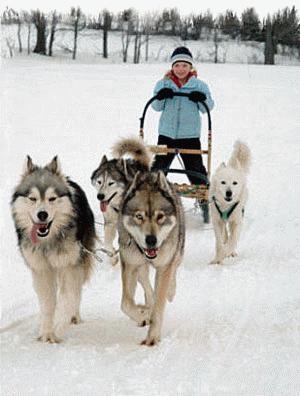
4. Dog sledding in Alaska

Dog sledding, or mushing, is Alaska's official sport. Enjoy the ride while a team of adorable huskies pulls you along for either a short sprint or a long journey. Dog sled rides can last anywhere from minutes to days, depending on your interests. Alaska Best Wilderness (www.alaskabestwilderness.com), based in Tanana, has 11-day backpacking expeditions that combine mushing, trekking and rafting. If you just want an afternoon with the beautiful sled dogs, Sun Dog Express (www.mosquitonet.com/~sleddog) in Fairbanks offers guided tours starting from just half a mile long.

5. Skijoring in Minnesota

For a snowy adventure with your own dogs, try skijoring in Minnesota. Skijoring is a combination of cross country skiing and dog sledding in which a person on skis is pulled along by his or her pups. The Midwest Skijorers Club (www.skijor.org) holds skijoring events around the Twin Cities in Minnesota.

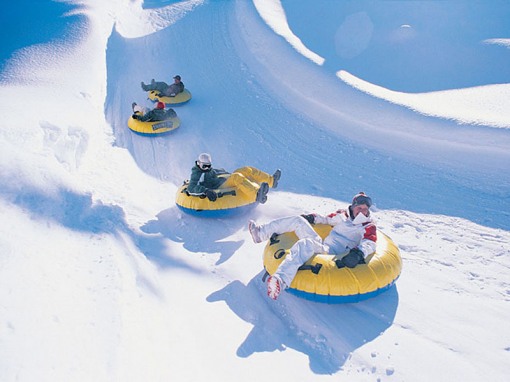
6. Snow tubing in Canada

Snow lovers who do not ski or snowboard will love snow tubing. Basically sledding in a tube, snowtubing is easy, cheap and incredibly fun. Rock Ridge Recreation Park (www.rockridgetubing.com) in Ontario is especially dedicated to the sport and features six tubing runs. Attach a few tubes together to go down the slopes with your friends or family. Rock Ridge's season this year begins the day after Christmas.

7. Ice climbing in Chile

True exhilaration can be found just outside of Santiago, Chile in Cajón del Maipo. There, the awe-inspiring El Morado Glacier sets the scene for a simultaneously magnificent, terrifying and thrilling ice climbing trip. Trek out to the southwest side of Cerro El Morado where the most adventurous of adventurers climb the hanging glacier. The sights are spectacular, so remember to bring a camera.

8. Ice sailing in Poland

Feel the blustery wind rush over you as you sail across Poland's Great Masurian Lakes when they freeze over in the winter. With no waves to slow you down, the sport brings new meaning to the term "smooth sailing". Iceboats can reach very high speeds, so racing should only be attempted after you get the hang of basic sailing.

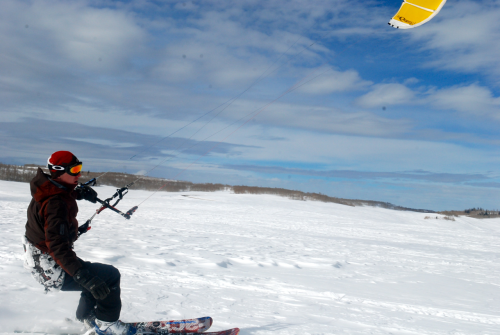
9. Snowkiting in Utah

While many snowkite enthusiasts use a board or skis, all you really need to go snowkiting is a power kite and an appetite for excitement. Glide down the slopes in snowy Utah and let the wind pull you up into the air. Lessons can be found at the Utah Kite Addiction (www.utahkiteaddiction.com) snowkiting school in the Ogden Valley. Beginners should take a class to learn the basics about snowkiting safety.

10. Shark ice fishing in Greenland

The Greenland Shark Challenge (www.greenland-guide.gl/sharkchallenge) is anything but your average fishing trip. Battle icy waters to catch Greenland's largest fish, the Greenland shark. These sharks can get reach 21 feet and 2,200 pounds, so reeling one in is a feat worthy of bragging rights. The Challenge takes place in the beautiful town of Uummannaq which boasts stunning views of glaciers and mountains. Book a fixed week-long fishing tour or arrange for an individual angling trip with a local fisherman.

Source: World Tour Guide 

Wednesday, December 22, 2010

Does reading a book make us happier?


Public libraries face an uncertain future but the value of reading is irreplaceable, says Joan Bakewell in her A Point of View column.

I was returning a library book last week. It had been important in some research I was doing so I sought to renew it. "No, I'm afraid it's in demand by someone else," came the reply.

A book first published in 1964 was still needed. I'm not surprised. Many books last a lifetime and go on being read. Then, on the library counter, I noticed printouts from our local newspaper. The headline was a question - Libraries slashed? - it asked.

I recall a Latin grammar construction defined as "expecting the answer 'yes'". I felt this applied to the headline. We in the London borough where I live know there will be massive council cuts. In London as a whole there are fears that 130 libraries could go.

And things are bad across the country. Buckinghamshire is said to be considering closing among others the Great Missenden library, inspiration for Roald Dahl's Matilda, who read library books. He would be appalled.

Another book event. Last week I helped celebrate the publication of probably the definitive account of the life and art of the painter LS Lowry, by Dr Tom Rosenthal. It was held in the gorgeous setting of Christies sales rooms, where a fine array of Lowry's work graced the walls.

I'm rather in awe of Point of View as it was once held by Alistair Cooke. It has a halo of significance. He was such an exemplar of the broadcast essay.

I'm interested in the way people use words and the way people talk about… having betrayed or broken promises and the nature of compromise.

In four decades (of journalism) I've been in touch with a great diversity of what people think and how they express themselves. I haven't spent a lifetime in studios and offices - I've been out there.

The Heart of the Matter tackled moral issues about current affairs. It tried to get people not to be of the left or of the right, but to think for themselves.
Later in the week some 20 of his paintings sold there for nearly £5.2m. There was an irony in seeing Lowry's bleak depictions of the Lancashire poor going for such high prices. Here they were, the huddled masses, hurrying from the factory, to the football match, crowding round a street accident, or spending their unsmiling leisure still fully clad on Lancashire's beaches.

Lowry's work divides people There are those who admire his bleak vision of the world he knew in the 30s and 40s, and those who demean it as nothing more than a host of matchstick men. I am of the former persuasion.

My reason is more than aesthetic, I have a local connection. My own great aunt lived in Salford at Crescent View, just such a row of terrace houses as Lowry painted. I knew the feel of Salford's streets, its little picket fences, and I loved the smell of Nana's stuffy kitchen, full of cooking and drying clothes.

The meaning of books came to me from just such a background. From the age of seven my father attended what was then called Chetham's Hospital in Manchester, a charity school for 40 poor boys founded in the 17th Century as the legacy of Humphrey Chetham. He was a wily old wool merchant whose motto "Quod tuum tene" - hold on to what is yours - just about sums up the industrial revolution that was to engulf the city and make it rich and make it poor.

But Chetham was a philanthropist and left provision not only for a school, but for a library within the same building. That library survives in its original glory - theology, law, local records, leather bound, beautifully preserved. Its Jacobean setting is one of the unsung treasures of Manchester, part of what is now the illustrious Chethams Music School.

The schoolboys in my father's day didn't read such books of course, they had their noses into Rider Haggard and Harrison Ainsworth. But my father - and his brothers - held the library in awe, acknowledging as everyone then did that learning and scholarship are among man's highest pursuits.

In the poverty that was then Salford, libraries were cherished. They were seen as the resource for the poor, where they could learn and begin to understand about the world beyond those Lowry streets.

The book I was returning to my local library is subtitled A Study in Protest. It is in fact an account by Christopher Driver of the rise of the anti-nuclear bomb campaigns of the late 50s and early 60s. Then as now, unruly groups grabbed the headlines. They always do.

But the book tells of concerted and sustained action to bring pressure on world powers to abandon nuclear weapons. We know they failed, but along the way they influenced public and world opinion to an extent that perhaps contributed to the test-ban treaties that were to be signed in the 1960s, in the years after the Cuba crisis.

The young have again been out on the streets in their thousands and students are meeting and plotting more protests even now. Will those of us who love libraries be able to make our voices heard? It would be hard to combat allegations of middle-class elitism, and indeed there is a case to answer.

If the pressure on finances is so great, at least as far as the coalition believe, then the availability of free books for all will need its defenders.

My defence should not be seen as the attempt merely to rescue a small building in a particular borough, or any other particular places threatened with closure. Rather it is a rallying call for the concept of free libraries. In our culture the library stands as tall and as significant as a parish church or the finest cathedral.

 It goes back to the times when ideas first began to circulate in the known world. I worry where wisdom will come from.

I am a major consumer of information on the internet. I know that academics and students access information there more quickly and more specifically than they can faced with a shelf load of books. But it's not that relationship I'm concerned about.

I offer you two scenarios. I am on a train going north, the scenery beyond York is glorious and in the slanting light of a winter afternoon has a magical quality not to miss.

So I put down the paperback to enjoy it, then I resume my read. Again, on holiday, deck chair beside a blue swimming pool, a landscape of rolling hills and green pastures unfolds before me. I set aside the paperback to enjoy the view, and then return to the pages.

I live with the tensions between the world out there I want to see and even contemplate, and the inner world to which the book gives me access. It is the inner rewards of reading a book in a private and concentrated way that lead you into realms of your own imagination and thought that no other process offers.

 Something happens between the words and the brain that is unique to the moment and to your own sensibilities.

It is why, at such moments, it is so awful to be interrupted - and why I am frequently late at meetings because I find it hard to tear myself away. Any society that doesn't value the richness of this encounter with ideas and the imagination will impoverish its citizens.

Of course, there are loads of books around. You can pick up a paperback for a few pounds that will last many years (my shelves are full of ageing paperbacks whose yellowing pages crack when I open them - only hardbacks last forever). Publishers think books are worth publishing, supermarkets think they are worth stacking on their shelves.

But these are market transactions. The free public library service is the only way for everyone to have access for free to objects that carry the world's wisdom.

Soon we will all be asked to tell the state what makes us happy, what increases our well-being. No doubt someone will come up with measurements of stress and depression.

We might be asked about our sense of neighbourliness or degrees of family closeness. Whether we are hungry or cold or neglected.

There are clearly data about social conditions that are worth collecting, but happiness is a dangerous word. It embraces all the subjectivity of our emotions and inner serenity.

It is a reflection of our character, the degree we are wracked by ambition or resentment, by envy or greed. It embraces what might be called spiritual well-being, the sort that might be underpinned by a happy marriage, a satisfying career, deep religious conviction.

Already television vox pops have asked people in the street what makes them happy and had replies that range from their children's laughter, to the music of Beethoven.

I think there might be many who consider one kind of happiness to be a deep armchair, a warm fire and a favourite book.
Related Posts Plugin for WordPress, Blogger...