skip to main |
skip to sidebar
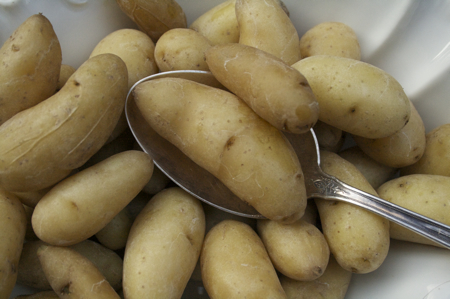
A man in the US has eaten nothing but 20 potatoes a day for the past two months. So, the Magazine asks, what does such a diet do to the body?
Chris Voigt's reason for eating potatoes, potatoes and nothing but potatoes is as plain and simple as his diet has been for the past two months.
As executive director of the Washington State Potato Commission, he's trying to debunk perceptions that potatoes are unhealthy and instead are a good source of fibre, potassium and vitamin C.
To that end, he's eaten nothing but 20 potatoes a day - no cheese toppings, no butter and milk for mashing - since 1 October. He's had them baked, chipped, boiled, steamed, mashed, fried - and for Thanksgiving last Thursday, he feasted on mashed potato formed into a turkey shape, and pumpkin pie made with - you guessed it - mashed potato with pumpkin pie flavouring added.
Nutritionist Fiona Hunter agrees that potatoes have a bad rep. "Although many people think potatoes are nothing more than starch carbs, they are a surprising source of several vitamins and minerals. However, eating just potatoes will not provide all the nutrients needed for good health."
Critics had warned Mr Voigt it would lead to weight gain, loss of energy and worryingly high blood sugar levels from all the carbohydrates.
But in the course of his two-month diet, Mr Voigt himself says he has lost 18 pounds. His previously borderline-high cholesterol has dropped - down 52 points at the half-way mark. And the family food bill is down as he can feed himself for $15 (£9.40) a week.
"Physically I feel great. Lots of energy, sleep good at night, no strange side-effects," says Mr Voigt from his office in Moses Lake, Washington state. "I'm not encouraging anyone to go on this crazy diet, nor would my doctor. This diet was just a bold statement to remind people that there is a lot of nutrition in a potato.
"My doctor is interested to see the final results, and he suspected I would be just fine at the end of 60 days."
While nutritionist Sue Todd wouldn't recommend such a diet, she says it has more going for it than some - especially if he was in reasonably good health to start with, and doesn't continue beyond 60 days.
"Sailors on long sea voyages used to get scurvy, because they ate mainly starches from grain, which contained no vitamin C. Potatoes are a decent source of vitamin C, although they are not high in it.
"Depending on how you restrict your diet, missing out on some vitamins affects you more than others. Variety is really important to get the nutrients our bodies need."
It is an eating regime that's low in fat, which she approves of, and by eating a good proportion of his potatoes with the skin on, the fibre Mr Voigt consumes cuts the risk of one-side effect associated with restricted diets - constipation.
But a potato-only diet provides none of the calcium and omega three - an essential fatty acid crucial for brain and heart function - needed for good health, says Ms Hunter.
"The body needs 40 nutrients to function and no single food will provide all of these, which is why the nutrition guidelines from groups like the Department of Health stress that we need to eat a variety of food.
"A diet of just potatoes will be deficient in vitamins A, E and K, the minerals calcium and selenium, essential fatty acids, protein and dietary fibre. Although they may provide enough iron for a man, they will not provide enough iron for women.
"One way of addressing the vitamin shortfall would be to substitute white potatoes with sweet potatoes, which have more vitamin E and A."
Mr Voigt did not take any multivitamins - something she says would help anyone undergoing this kind of regime.
And when his diet ends, what will that do to his body? Ms Todd warns of possible digestive discomfort as his system readjusts.
"He should ease himself out of it and not eat too much meat too soon, as it takes longer to digest."
So what is Mr Voigt planning to eat once freed from his self-imposed diet?
"I think my first meal is going to be a spicy beef taco, a glass of milk, a crunchy apple, and yes… roasted potatoes."
Source: BBC magazine
Showing posts with label Amazing Bridges. Show all posts
Friday, December 24, 2010
Is a potato-only diet good for you?
A man in the US has eaten nothing but 20 potatoes a day for the past two months. So, the Magazine asks, what does such a diet do to the body?
Chris Voigt's reason for eating potatoes, potatoes and nothing but potatoes is as plain and simple as his diet has been for the past two months.
As executive director of the Washington State Potato Commission, he's trying to debunk perceptions that potatoes are unhealthy and instead are a good source of fibre, potassium and vitamin C.
To that end, he's eaten nothing but 20 potatoes a day - no cheese toppings, no butter and milk for mashing - since 1 October. He's had them baked, chipped, boiled, steamed, mashed, fried - and for Thanksgiving last Thursday, he feasted on mashed potato formed into a turkey shape, and pumpkin pie made with - you guessed it - mashed potato with pumpkin pie flavouring added.
Nutritionist Fiona Hunter agrees that potatoes have a bad rep. "Although many people think potatoes are nothing more than starch carbs, they are a surprising source of several vitamins and minerals. However, eating just potatoes will not provide all the nutrients needed for good health."
Critics had warned Mr Voigt it would lead to weight gain, loss of energy and worryingly high blood sugar levels from all the carbohydrates.
But in the course of his two-month diet, Mr Voigt himself says he has lost 18 pounds. His previously borderline-high cholesterol has dropped - down 52 points at the half-way mark. And the family food bill is down as he can feed himself for $15 (£9.40) a week.
"Physically I feel great. Lots of energy, sleep good at night, no strange side-effects," says Mr Voigt from his office in Moses Lake, Washington state. "I'm not encouraging anyone to go on this crazy diet, nor would my doctor. This diet was just a bold statement to remind people that there is a lot of nutrition in a potato.
"My doctor is interested to see the final results, and he suspected I would be just fine at the end of 60 days."
While nutritionist Sue Todd wouldn't recommend such a diet, she says it has more going for it than some - especially if he was in reasonably good health to start with, and doesn't continue beyond 60 days.
"Sailors on long sea voyages used to get scurvy, because they ate mainly starches from grain, which contained no vitamin C. Potatoes are a decent source of vitamin C, although they are not high in it.
"Depending on how you restrict your diet, missing out on some vitamins affects you more than others. Variety is really important to get the nutrients our bodies need."
It is an eating regime that's low in fat, which she approves of, and by eating a good proportion of his potatoes with the skin on, the fibre Mr Voigt consumes cuts the risk of one-side effect associated with restricted diets - constipation.
But a potato-only diet provides none of the calcium and omega three - an essential fatty acid crucial for brain and heart function - needed for good health, says Ms Hunter.
"The body needs 40 nutrients to function and no single food will provide all of these, which is why the nutrition guidelines from groups like the Department of Health stress that we need to eat a variety of food.
"A diet of just potatoes will be deficient in vitamins A, E and K, the minerals calcium and selenium, essential fatty acids, protein and dietary fibre. Although they may provide enough iron for a man, they will not provide enough iron for women.
"One way of addressing the vitamin shortfall would be to substitute white potatoes with sweet potatoes, which have more vitamin E and A."
Mr Voigt did not take any multivitamins - something she says would help anyone undergoing this kind of regime.
And when his diet ends, what will that do to his body? Ms Todd warns of possible digestive discomfort as his system readjusts.
"He should ease himself out of it and not eat too much meat too soon, as it takes longer to digest."
So what is Mr Voigt planning to eat once freed from his self-imposed diet?
"I think my first meal is going to be a spicy beef taco, a glass of milk, a crunchy apple, and yes… roasted potatoes."
Source: BBC magazine
Sunday, August 22, 2010
Saturday, May 8, 2010
The World's Strangest Bridges: Gallery
By Chris Sweeney
www.popularmechanics.com
Some bridges are engineered with nothing but utility in mind -- for these, aesthetic design is secondary to safety and longevity. And given that San Francisco's Bay Bridge was just closed for six days, this makes sense. But advances in design software and construction materials have given bridge architects opportunities to focus on original, striking and sometimes whimsical designs that impress, while keeping function in mind. Here are some of our favorite unusual bridges and why they're architecturally striking.
Rolling Bridge
Why It's Innovative: A hydraulic system built into the bridge's handrail allows it to retract and curl into an octagon. The retractable design allows for boats to cruise through the canal unobstructed, and the bridge rolls up every Friday at noon.
Donald MacDonald, an architect with more than 40 years of experience who has worked on over a dozen bridges, tells PM that, "this bridge represents an experimental gesture, and it's really complicated for what it does."
Henderson Waves
Background: The 118-foot tall Henderson Waves is Singapore's tallest pedestrian bridge, linking Mount Faber Park with Telok Blangah Hill Park.
Why It's Innovative: Pedestrian bridges allow for a certain amount of creativity that's not possible with structures that need to support heavy- duty use. The undulating outer shell of the Henderson Waves is striking, and the inside is shaped into benches where tourists can sit and gaze at nature or the nearby skyline of Singapore City. The bridge, which is about 900 feet long, is illuminated by an array of LED lights each night to bolster its snake-like presence in the midst of two national parks.
Sundial Bridge
Background: Renowned Spanish architect Santiago Calatrava designed this cantilever spar cable-stayed bridge to be made from a combination of steel, glass and granite. Completed in 2004, the pedestrian bridge crosses the Sacramento River in the Turtle Bay Exploration Park.
Why It's Innovative: As its name implies, the bridge's 217-foot-tall support tower acts as a giant sundial. The deck of this pedestrian bridge is made from nonskid glass panels to give walkers a greater sense of the river. MacDonald notes that the deck's truss bears the bulk of the bridge's load, while the cables appear slack compared with those of other bridges.
Juscelino Kubitschek Bridge
Background: Completed in 2002, this asymmetrical bridge crosses Lake Paranoa. Its name pays homage to former Brazilian president Juscelino Kubitschek, who established Brasilia as the nation's capital in the 1950s.
Why It's Innovative: Three steel arches that jump from side to side support the deck of the 3900-foot-long bridge. Architect Alexandre Chan, who designed the bridge, has said that he wanted to avoid straight lines on the deck in order to accentuate Brasilia's striking sunsets.
Millau Viaduct
Why It's Innovative: With its apex at 1125 feet, the Millau Viaduct is one of the world's tallest bridges. Despite its huge size, the construction period lasted only three years thanks to the use of GPS guidance systems, self-climbing formwork and prefabricated materials. "What is unusual is to have the towers taper in both directions as they rise," Macdonald says.
More than 1500 tons of cables support the 1.5-mile structure. Because its deck is 885 feet above sea level, drivers often find themselves above the clouds on foggy days.
Why It's Innovative: Set above the treetops, the Langkawi Sky Bridge is one of the highest elevated single-stay bridges in the world. The deck is less than 6 feet wide and its curved shape gives travelers a panoramic view of Langkawi, an archipelago of 99 islands. Each end is fitted with triangular observation decks.
Da Vinci Bridge
Background: Leonardo Da Vinci sketched plans for this bridge in 1502 for Sultan Bajazet II of Constantinople, but it wasn't until 500 years later that the design was brought to life by Norweigan artist Vebjørn Sand. The pedestrian bridge opened in 2001 and crosses the E18 highway.
Why It's Innovative: For centuries it was thought that Da Vinci's sketch of the bridge was implausible. The bowed arches of the single-span design are dramatically thin where they connect with the walkway, but they flare out as they approach the ground. Da Vinci's original plan called for the span to be 720 feet long, but Sand and colleagues scaled it down to 300 feet and built the walkway from Norwegian pine.
Gateshead Millennium Bridge
Background: This award-winning tilt-bridge is the brainchild of Wilkinson Eyre, a London-based architecture firm. It crosses the River Tyne, connecting Gateshead and New Castle.
Why It's Innovative: A system of six hydraulic rams can pivot the bridge's walkway at a 40-degree angle in order to let boats pass. Wilkinson Eyre describes the bridge's movement as looking like a "slowly opening eyelid" when it raises, a process that takes fewer than 5 minutes. Perhaps even more impressive is the fact that the bridge was fully constructed before being installed as a single piece by Europe's largest floating crane, Asian Hercules II.
Oresund Bridge
Background: The Oresund Bridge crosses the Oresund strait and joins Sweden with Denmark. This marvel of ingenuity has a total length of 4.8 miles and was completed in 2000.
Why It's Innovative: The Oresund Bridge is an incredibly complex structure that begins as a cable-stayed bridge in Sweden and ends as a tunnel in Denmark. A small artificial island was built around the tunnel's entrance to keep water from creeping in. Not only is the bridge equipped to handle four lanes of traffic; it also has a double-track railway. Creating the tunnel was likely the best and cheapest solution to completing the crossing without impeding boat traffic, MacDonald says.
Octavio Frias de Oliveira Bridge
Background: This mammoth, x-shaped, cable-stayed bridge was completed in 2008 over the Pinheiros River in São Paulo. The peak of its pylon is 452 feet high, while the bridge's total length is just shy of a mile.
Why It's Innovative: The most noticeable attribute of the bridge is how its two levels of traffic cross one another as they pass through the pylon. A series of 144 steel cables were used to support the structure. Brazil spared no expense on this masterpiece; Philips was contracted to develop an energy-efficient system of LED lights that showers the bridge in changing colors and patterns, which the company says consumes 53 percent less energy compared to lighting on other bridges.
www.popularmechanics.com
Some bridges are engineered with nothing but utility in mind -- for these, aesthetic design is secondary to safety and longevity. And given that San Francisco's Bay Bridge was just closed for six days, this makes sense. But advances in design software and construction materials have given bridge architects opportunities to focus on original, striking and sometimes whimsical designs that impress, while keeping function in mind. Here are some of our favorite unusual bridges and why they're architecturally striking.
Rolling Bridge
Background: UK-based design firm Heatherwick Studio created this 39-foot timber and steel bridge in 2004 to act as a walkway over a small section of London's Grand Union Canal.
Why It's Innovative: A hydraulic system built into the bridge's handrail allows it to retract and curl into an octagon. The retractable design allows for boats to cruise through the canal unobstructed, and the bridge rolls up every Friday at noon.
Donald MacDonald, an architect with more than 40 years of experience who has worked on over a dozen bridges, tells PM that, "this bridge represents an experimental gesture, and it's really complicated for what it does."
Henderson Waves
Background: The 118-foot tall Henderson Waves is Singapore's tallest pedestrian bridge, linking Mount Faber Park with Telok Blangah Hill Park.
Why It's Innovative: Pedestrian bridges allow for a certain amount of creativity that's not possible with structures that need to support heavy- duty use. The undulating outer shell of the Henderson Waves is striking, and the inside is shaped into benches where tourists can sit and gaze at nature or the nearby skyline of Singapore City. The bridge, which is about 900 feet long, is illuminated by an array of LED lights each night to bolster its snake-like presence in the midst of two national parks.
Sundial Bridge
Background: Renowned Spanish architect Santiago Calatrava designed this cantilever spar cable-stayed bridge to be made from a combination of steel, glass and granite. Completed in 2004, the pedestrian bridge crosses the Sacramento River in the Turtle Bay Exploration Park.
Why It's Innovative: As its name implies, the bridge's 217-foot-tall support tower acts as a giant sundial. The deck of this pedestrian bridge is made from nonskid glass panels to give walkers a greater sense of the river. MacDonald notes that the deck's truss bears the bulk of the bridge's load, while the cables appear slack compared with those of other bridges.
Juscelino Kubitschek Bridge
Background: Completed in 2002, this asymmetrical bridge crosses Lake Paranoa. Its name pays homage to former Brazilian president Juscelino Kubitschek, who established Brasilia as the nation's capital in the 1950s.
Why It's Innovative: Three steel arches that jump from side to side support the deck of the 3900-foot-long bridge. Architect Alexandre Chan, who designed the bridge, has said that he wanted to avoid straight lines on the deck in order to accentuate Brasilia's striking sunsets.
Millau Viaduct
Background: English architect Norman Foster designed this massive cable-stayed bridge to carry travelers over the valley of the Tarn River. It opened in 2004 with a final price tag of nearly $600 million.
Why It's Innovative: With its apex at 1125 feet, the Millau Viaduct is one of the world's tallest bridges. Despite its huge size, the construction period lasted only three years thanks to the use of GPS guidance systems, self-climbing formwork and prefabricated materials. "What is unusual is to have the towers taper in both directions as they rise," Macdonald says.
More than 1500 tons of cables support the 1.5-mile structure. Because its deck is 885 feet above sea level, drivers often find themselves above the clouds on foggy days.
Background: This curved pedestrian bridge is 2000 feet above sea level at the top of Mount Mat Cincang in Malaysia. Tourists who want to walk across the 400-foot long structure must ride up to it in a cable car.
Da Vinci Bridge
Background: Leonardo Da Vinci sketched plans for this bridge in 1502 for Sultan Bajazet II of Constantinople, but it wasn't until 500 years later that the design was brought to life by Norweigan artist Vebjørn Sand. The pedestrian bridge opened in 2001 and crosses the E18 highway.
Why It's Innovative: For centuries it was thought that Da Vinci's sketch of the bridge was implausible. The bowed arches of the single-span design are dramatically thin where they connect with the walkway, but they flare out as they approach the ground. Da Vinci's original plan called for the span to be 720 feet long, but Sand and colleagues scaled it down to 300 feet and built the walkway from Norwegian pine.
Gateshead Millennium Bridge
Background: This award-winning tilt-bridge is the brainchild of Wilkinson Eyre, a London-based architecture firm. It crosses the River Tyne, connecting Gateshead and New Castle.
Why It's Innovative: A system of six hydraulic rams can pivot the bridge's walkway at a 40-degree angle in order to let boats pass. Wilkinson Eyre describes the bridge's movement as looking like a "slowly opening eyelid" when it raises, a process that takes fewer than 5 minutes. Perhaps even more impressive is the fact that the bridge was fully constructed before being installed as a single piece by Europe's largest floating crane, Asian Hercules II.
Oresund Bridge
Background: The Oresund Bridge crosses the Oresund strait and joins Sweden with Denmark. This marvel of ingenuity has a total length of 4.8 miles and was completed in 2000.
Why It's Innovative: The Oresund Bridge is an incredibly complex structure that begins as a cable-stayed bridge in Sweden and ends as a tunnel in Denmark. A small artificial island was built around the tunnel's entrance to keep water from creeping in. Not only is the bridge equipped to handle four lanes of traffic; it also has a double-track railway. Creating the tunnel was likely the best and cheapest solution to completing the crossing without impeding boat traffic, MacDonald says.
Octavio Frias de Oliveira Bridge
Background: This mammoth, x-shaped, cable-stayed bridge was completed in 2008 over the Pinheiros River in São Paulo. The peak of its pylon is 452 feet high, while the bridge's total length is just shy of a mile.
Why It's Innovative: The most noticeable attribute of the bridge is how its two levels of traffic cross one another as they pass through the pylon. A series of 144 steel cables were used to support the structure. Brazil spared no expense on this masterpiece; Philips was contracted to develop an energy-efficient system of LED lights that showers the bridge in changing colors and patterns, which the company says consumes 53 percent less energy compared to lighting on other bridges.
About Me
- Nairuz
- Hi Everyone This a blog about different, amazing, weird and valuable news around the worlds that I gather from many of places to enlighten our knowledge and follow the fast paces of the world.
Total Pageviews
Labels
- Advices (4)
- Amazing (1)
- Amazing Bridges (3)
- Animals (11)
- Animals World (1)
- Art (2)
- Articles (5)
- Biology (2)
- Birds (4)
- Breakthroughs (1)
- Cars (1)
- Celebrations (2)
- Cell phones (2)
- Cheetah Family (1)
- Comments (1)
- Computers (1)
- Congress (1)
- Countries (1)
- Culture (1)
- Customs (1)
- Deer (1)
- Designs (4)
- Did you Know (40)
- Diet (17)
- Education (5)
- Electronics (4)
- Entertainment (38)
- Entertainment.jokes (2)
- Environment (11)
- Exercise (1)
- Facts (71)
- Facts about World Cup (1)
- Fish (1)
- Food (20)
- Forests (1)
- Friendship (1)
- Fuji (1)
- Gadgets (1)
- General News (33)
- Governments (1)
- Health (57)
- History (4)
- Holidays (2)
- Insects (2)
- Internet (4)
- Japan (1)
- Jungle (1)
- l News (3)
- Leisure (2)
- Life (22)
- Love (1)
- Medicine (5)
- Mount (1)
- News (18)
- Nutrients (1)
- Occasions (3)
- ODD (18)
- p (1)
- People (1)
- Photos (9)
- Politics (3)
- Psychology (6)
- Questions (6)
- Quotation of the Day (15)
- Quotation of the Day.Creativity (6)
- Religions (1)
- Remedies (2)
- Richest (1)
- Rituals (2)
- Science (101)
- Sea World (2)
- Sepcial Stories (20)
- Sepcials (34)
- Socials (3)
- Space (3)
- Special Places (2)
- Special Stories (3)
- Specials (53)
- Sport (1)
- Sports (7)
- Tech (13)
- Tigers (1)
- Tops (1)
- Travel (2)
- Weird (5)
- Weird Customs (1)
- Weird News (10)
- Wise Quotation (10)
- World Cup (3)
- World Facts (3)
Popular Posts
-
By Jen Drake, eHow Contributing Writer Bovinae is a scientific classification for a specific subfamily of mammals that includes cows, oxen...
-
1-Stockholm Tunnelbana (Sweden) `Subway stations are usually designed in a clean and modernistic style in order to make people forget they...
-
In a perfect world, everyone would work out enough and eat right all the time. But that's not always possible, so we turned to the expe...
-
Birds daub pink-producing oil onto feathers during mating season. There's a reason why flamingos are so pretty in pink: The birds ap...
-
Trying to get more shut-eye? Take a look at your diet. Eating the right foods in the hours before you hit the hay may help you fall asleep ...
Blog Archive
Visitors
Hits
Followers
Powered by Blogger.
by : arab-alrab7on
My Blog List
-
-
This Turkish Ice Cream Man Is the Ultimate Prankster - Imagine a world where buying ice cream isn’t just about preparing to eat a delicious frozen treat, but also about the ice cream man pulling entertaining...12 years ago
-


